
.png?width=64&height=64&name=header%20product%20icons%20%20(9).png)
.png?width=64&height=64&name=header%20product%20icons%20%20(1).png)
.png?width=64&height=68&name=header%20product%20icons%20%20(2).png)
.png?width=64&height=64&name=header%20product%20icons%20%20(5).png)
.png?width=64&height=64&name=header%20product%20icons%20%20(4).png)
.png?width=64&height=64&name=header%20product%20icons%20%20(3).png)
.png?width=64&height=64&name=header%20product%20icons%20%20(11).png)
.png?width=64&height=64&name=header%20product%20icons%20%20(10).png)
.png?width=64&height=64&name=header%20product%20icons%20%20(6).png)
.png?width=64&height=64&name=header%20product%20icons%20%20(12).png)
.png?width=64&height=65&name=header%20product%20icons%20%20(28).png)
.png?width=64&height=64&name=header%20product%20icons%20%20(30).png)
.png?width=64&height=64&name=header%20product%20icons%20%20(13).png)
.png?width=64&height=64&name=header%20product%20icons%20%20(15).png)
.png?width=64&height=64&name=header%20product%20icons%20%20(14).png)
.png?width=156&height=156&name=header%20product%20icons%20%20(44).png)
.png?width=64&height=64&name=header%20product%20icons%20%20(16).png)
.png?width=64&height=64&name=header%20product%20icons%20%20(19).png)
.png?width=64&height=64&name=header%20product%20icons%20%20(17).png)
.png?width=64&height=64&name=header%20product%20icons%20%20(18).png)
.png?width=64&height=64&name=header%20product%20icons%20%20(20).png)
.png?width=64&height=64&name=header%20product%20icons%20%20(21).png)
.png?width=64&height=64&name=header%20product%20icons%20%20(24).png)
.png?width=64&height=64&name=header%20product%20icons%20%20(26).png)
.png?width=64&height=64&name=header%20product%20icons%20%20(23).png)
.png?width=64&height=64&name=header%20product%20icons%20%20(22).png)
.png?width=64&height=64&name=header%20product%20icons%20%20(25).png)
.png?width=64&height=64&name=header%20product%20icons%20%20(27).png)
 By
·
8 minute read
By
·
8 minute read
Marketing Mix Modeling (MMM) is a statistical method that quantifies the impact of marketing and non-marketing factors on sales or revenue. Using aggregate historical data - not individual user tracking - MMM measures the ROI of every channel from TV and paid search to promotions and pricing, in a privacy-safe way. The output guides budget allocation, scenario planning, and long-term strategy.
What does marketing mix modeling (MMM) mean?
Marketing Mix Modeling (MMM) is a statistical approach to measure the impact of marketing and non-marketing factors on sales. It helps quantify ROI across channels — TV, radio, digital, promotions, pricing, and more — using aggregate data in a privacy-safe way. MMM is often used in conjunction with MTA (multi touch attribution) and Experiments (such as A/B tests or geo-based lift studies) to provide a total view of marketing effectiveness. They provide complementary perspectives: MTA for granular, user-level insights, Experiments for validating what drives incremental lift, and MMM for cross-channel, strategic planning. A well-built MMM model can guide budget allocation, scenario planning, and ongoing performance optimization.
Marketing Mix Modeling is also widely referred to as Media Mix Modeling, both terms are abbreviated MMM and used interchangeably across the industry. Technically, media mix modeling refers specifically to paid media channels, while marketing mix modeling encompasses the full marketing mix including pricing, promotions, and distribution. In practice, most practitioners use MMM to mean both.
What is the Purpose of Marketing Mix Modeling?
The core purpose of Marketing Mix Modeling (MMM) is to answer a deceptively simple question: “What’s working, and what’s not?” For performance marketers, especially in FMCG, this question is central to justifying spend and driving growth. MMM helps quantify the incremental impact of each marketing channel, optimize budget allocation across media, promotions, and pricing levers, forecast outcomes under different spend scenarios, and prove marketing effectiveness to finance and executive stakeholders. In short, MMM turns marketing from a cost center into a measurable growth engine.
How Does Marketing Mix Modeling Work?
At its core, MMM uses regression analysis to isolate the effect of each marketing input on a business KPI — typically sales or revenue. The model ingests a wide range of inputs, including media spend across channels like TV, digital, print, and out-of-home; promotional activity and discounting; pricing changes; distribution and availability; seasonality and macroeconomic factors; and even competitor activity. The output is a set of insights that quantify the return on investment (ROI) for each channel, distinguish between base and incremental sales, identify diminishing returns curves, and recommend optimal budget allocations. Two transformations make MMM accurate for real-world media behavior. Adstock (or carryover) captures the fact that advertising effects decay over time rather than stopping the day a campaign ends — at different rates for different channels. Saturation curves capture diminishing returns: each additional dollar spent on a channel generates progressively less incremental sales, which is what makes identifying an optimal spend level possible rather than guesswork.
How adstock and saturation interact in model estimation, and why getting it wrong produces unreliable results, is explained in this technical deep-dive by Ted Lorenzen.
Is marketing mix modeling the same as econometric modeling?
Marketing Mix Modeling is a specific application of econometric modeling — not a separate discipline. Econometrics is the broader field of applying statistical methods to economic data to understand causal relationships. MMM uses these same techniques, particularly regression analysis, but applies them to a specific marketing problem: isolating the contribution of individual marketing variables on a business outcome such as sales or revenue. When practitioners refer to "econometric modeling" in a marketing context, they typically mean MMM. The terms are functionally equivalent in this setting.
What Is an Example of a Marketing Mix Model?
Consider a CPG brand like Carlsberg running campaigns across TV, YouTube, and in-store promotions. An MMM analysis might reveal that TV drives strong top-of-funnel awareness but exhibits diminishing returns after €1.5M per month. YouTube, on the other hand, may deliver a higher ROI per euro spent, particularly among 18–34-year-olds. In-store promotions might boost short-term sales but cannibalize future demand if overused. With this insight, the brand could reallocate 15% of its TV budget to YouTube, limit promotions to once per quarter, and increase investment in regions with higher media elasticity. These are not just tactical tweaks — they’re strategic shifts grounded in evidence.
.png?width=1920&height=1080&name=%D0%9C%D0%9C%D0%9C%20video%20%20(1).png) MMM Tooling: Choosing the Right Engine for Your Analysis
MMM Tooling: Choosing the Right Engine for Your Analysis
There’s a growing range of Marketing Mix Modeling tools available today. Some organizations build models in-house using statistical programming languages. Others rely on consultancy-led approaches. Increasingly, SaaS platforms are emerging that promise faster deployment and greater accessibility. The right choice depends on your internal expertise, governance requirements, and how often you want to refresh and refine your models.
What matters most, however, is not simply whether a model can be built but how quickly it can start generating reliable insight, how transparently it can be validated, and how easily it can be used by the wider business.
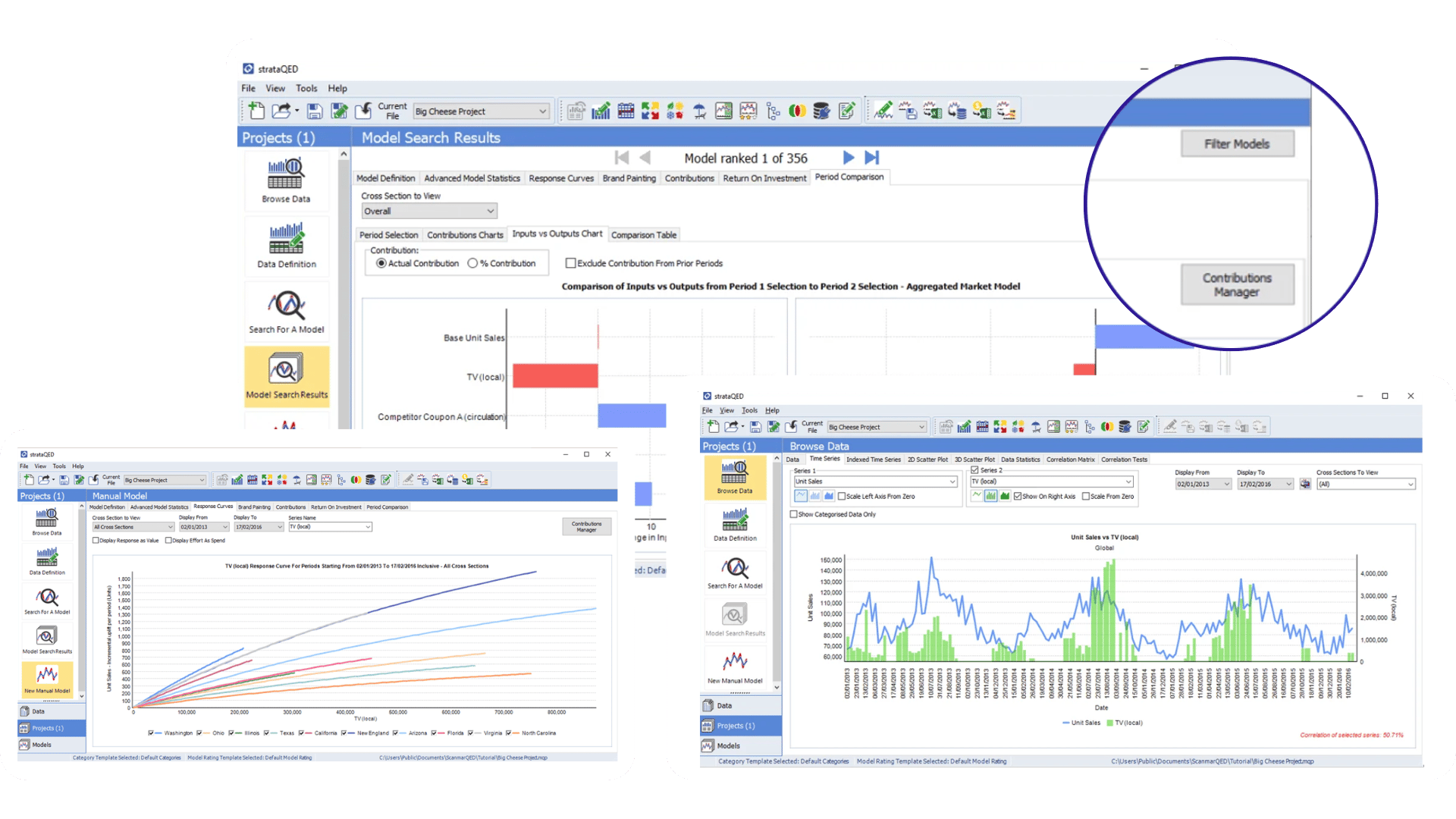
This is where dedicated MMM platforms such as strataQED come into play. strataQED is designed to reduce the time between data preparation and actionable results. Its automated workflows and intelligent model-search capabilities mean teams can move from integrated data to exploratory models quickly, without spending weeks manually specifying and testing regressions. This means that from initial data integration you can have your first exploratory models live within a couple of hours. Importantly, speed does not come at the expense of rigor. Users retain full control over model refinement, validation, and iteration. Once the initial models are live, it is up to the analyst how far to optimize and tune them — whether that’s building fast answers for an upcoming budget cycle or continuously improving models as new data becomes available.
How do MMM, MTA, and Experiments differ?
While MMM, MTA, and Experiments all aim to measure marketing effectiveness, they operate on fundamentally different principles. In practice, the most effective marketers don’t treat them as substitutes, but as complements.
MMM focuses on broader patterns and relationships across time. MMM uses aggregate data, such as weekly sales, and captures both online and offline channels, making it ideal for strategic planning. MTA, by contrast, looks at individual customer journeys and brings granularity into how digital touchpoints influence conversion paths, making it better suited for tactical optimization. Experiments measure causal impact directly, allowing marketers to validate assumptions, quantify incremental lift, and test specific channels.
In essence, MMM provides the strategic compass, MTA offers the tactical GPS, and Experiments deliver the reality check, confirming which marketing actions truly drive results. This integrated approach ensures marketers can adapt to privacy changes, manage budgets with confidence, and capture both the long-term effects and the fast-moving nuances of digital behavior.
Why Is MMM Relevant in the Age of AI and Automation?
Modern MMM is not your grandfather’s spreadsheet model. Today’s models are powered by machine learning to handle complex interactions and non-linear effects. They are updated frequently — weekly or monthly — thanks to automation and integrated with dashboards for real-time scenario planning. The role of AI in modern MMM is most valuable in the model-building phase itself. Platforms like ScanmarQED's strataQED use a machine learning model search engine, based on genetic algorithms, to test all viable model candidates and identify the best one for a given marketing context. This means expert time goes to interpretation and decisions rather than manual iteration through model specifications.
AI has also changed what it means to trust an MMM result. Historically, a model's conclusions were only as credible as the single methodology behind them - and that methodology was rarely visible to the people acting on it. Today, running multiple independent modeling engines on the same data and asking whether they agree is a meaningful test of whether a finding is real. ScanmarQED's MMM Labs is built around this principle: Robyn, Meridian, PyMC, and a proprietary engine running side by side in one interface, so teams can see where methodologies converge — and where they diverge. Convergence is evidence. Divergence is a question worth asking before a budget decision is made.
“MMM helped us uncover that 30% of our digital spend was underperforming. We reallocated that budget and saw a 12% lift in ROI within a quarter.”
— Marketing Effectiveness Lead, FMCG
Key Takeaways on Marketing Mix Modeling (MMM)
- MMM is a statistical method for measuring the impact of marketing and non-marketing factors on sales.
- It quantifies ROI across channels — TV, radio, digital, promotions, pricing, and more.
- It’s privacy-safe and does not rely on user-level data.
- MMM using aggregate data across both online and offline channels, providing a broader, complementary view of marketing performance.
- It supports budget allocation, scenario planning, and performance optimization.
Strategic Takeaway
Marketing Mix Modeling is not just a measurement tool — it’s a strategic compass. For performance marketers navigating fragmented data, rising media costs, and increasing pressure to prove ROI, MMM offers clarity, credibility, and control. It empowers teams to optimize spend, forecast outcomes, and communicate value to stakeholders with confidence. If you're not using MMM yet, you're likely leaving money — and insight — on the table.